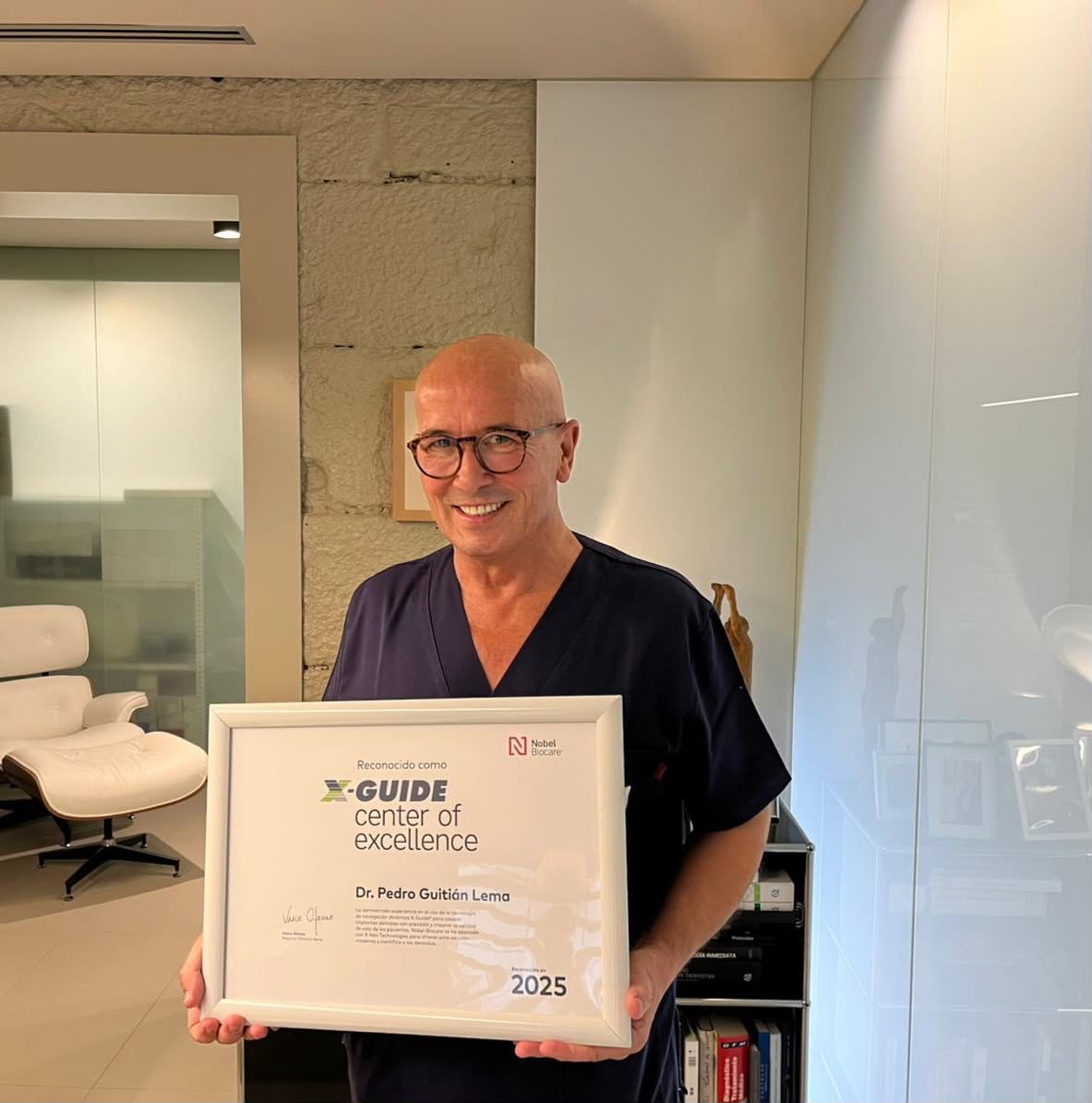
Dr. Pedro Guitián, co-founder of HISTORA and practicing oral surgeon, has received recognition for his work in navigated dental surgery — a rapidly advancing field that combines 3D imaging, computer-guided planning, and real-time surgical navigation to improve precision and safety in complex dental procedures.
What is navigated dental surgery?
Navigated dental surgery refers to procedures where the surgeon uses real-time computer guidance — informed by pre-operative CBCT 3D scans and surgical planning software — to place implants, extract complex impacted teeth, or perform other precise surgical interventions.
The technology works as follows:
- Pre-operative CBCT scan: A 3D cone beam CT scan captures the patient's bone anatomy, nerve pathways, sinus structures, and existing dentition in detail.
- Surgical planning: The surgeon plans the procedure digitally — marking implant position, depth, angle, and proximity to anatomical structures.
- Real-time navigation: During surgery, optical or electromagnetic trackers communicate the position of surgical instruments relative to the 3D anatomy in real time, displayed on a monitor.
This approach reduces implant malposition, decreases post-operative complications, and is particularly valuable in complex cases with limited bone volume, proximity to nerves, or full-arch implant planning.
The data management problem in navigated surgery
Navigated surgery is data-intensive in a way that exposes the underlying fragility of dental data infrastructure.
Pre-operative CBCT files can be 200–800MB. They must be accessible to:
- The oral surgeon performing the procedure
- The general dentist who initiated the referral
- The implant planning software (often a third party)
- Sometimes, the implant company's engineering team for custom prosthetic planning
Coordinating this data transfer using the current standard — physical media, consumer cloud storage, or clinic-specific PACS systems — is one of the most friction-filled parts of surgical implant workflows.
Dr. Guitián's clinical experience with this exact friction was a direct driver of HISTORA's development. The platform's browser-native DICOM viewer and instant file sharing were built with navigated surgical workflows explicitly in mind.
Recognition and clinical context
Dr. Guitián's recognition reflects the broader clinical community's appreciation for work that bridges two domains that rarely talk to each other: surgical precision and digital data infrastructure.
His work demonstrates that the technical challenge of navigated surgery isn't only in the operating room — it's also in making the data that enables surgical navigation accessible, shareable, and persistent across the care team.
Learn more about how HISTORA supports complex dental workflows, including navigated surgery, in our features overview.